Dead Battery in Cold Weather: What to Do First
If your car won’t start in freezing weather, inspect the battery first, then check for freeze damage. If the battery looks damaged, do not jump-start it; arrange a tow or replacement instead. A bad jump or a frozen battery can spark, spray acid, cause another no-start, or damage the charging system. Use this winter triage sequence: inspect, decide whether to jump-start, tow, or replace, and avoid errors that turn a dead battery into a bigger problem.
This guide is part of our Dead battery: symptoms, fixes, and next steps series.
What to do first
The first 60 seconds are usually a check, not a guess. Look at the battery case, listen to the start behavior, and scan for a battery warning light before you touch cables. A lead-acid car battery slows down in cold weather, so the same battery can act weak, stall at the starter, or freeze if it was already deeply discharged.
- Turn the key or press the start button once and note the sound.
- Watch for one click, rapid clicking, or no crank at all.
- Open the hood and inspect the battery case for bulging, cracking, or leakage.
- Check the dash for a battery warning light.
- Decide whether you should jump, tow, or wait for thawing before you try anything else.
Picture a sedan at 0°F with a single heavy click and no crank. That pattern points more toward a weak battery than a seized engine, but a swollen case changes the call completely. If the battery looks damaged, skip the jump and move straight to tow or replacement.
What you’ll need
- Heavy-duty jumper cables with clean clamps
- Portable jump starter with enough charge for winter use
- Gloves and a flashlight
- Owner’s manuals for both vehicles if you are jump-starting
- Dry, stable footing near the vehicles
- A clear place to stand safely at the roadside
Cold weather is harder on tools too. Jumper cables should be quality and heavy-duty, because stiff insulation and weak clamps are worse in winter. A portable jump starter can live in a glove box or center console, and a unit with a pre-heat function is useful in cold climates.
Dead battery winter checklist
| Branch | Condition checks | Action | Next step window |
|---|---|---|---|
| Safe to jump | No bulge, no crack, no leak; no strong sulfur smell; no battery light before the failed start; the car gives one click or rapid clicking | Jump-start with correct polarity and a ground on bare metal | Try once, then reassess within 5 to 10 minutes |
| Tow immediately | Battery case bulged, cracked, leaking, or visibly damaged; roadside is unsafe; repeated jump attempts already failed; battery light stays on after a restart | Stop cranking and call tow service | Now |
| Replace after thawing | Battery was deeply discharged, may have frozen, or is older than three years and has poor winter performance | Let it thaw, then load-test and replace if it will not meet rated output | Same day after thaw and test |
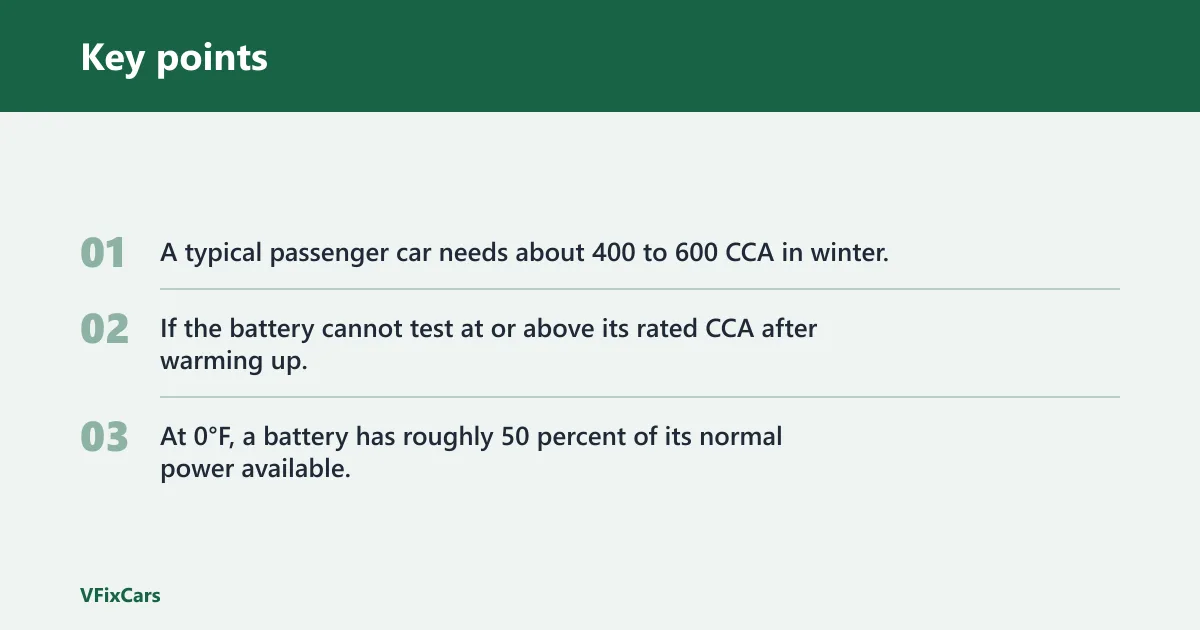
A typical passenger car needs about 400 to 600 CCA in winter. If the battery cannot test at or above its rated CCA after warming up, it is not a reliable winter battery. At 0°F, a battery has roughly 50 percent of its normal power available, so borderline batteries fail fast.
Can you jump it safely?
Yes, but only if the battery case is intact and the car is not showing signs of freeze damage. Follow both vehicles’ manuals before connecting anything, because some vehicles have approved jump points or special procedures. If cable access is awkward or the car is parked badly, a portable jump starter is often the cleaner winter option.
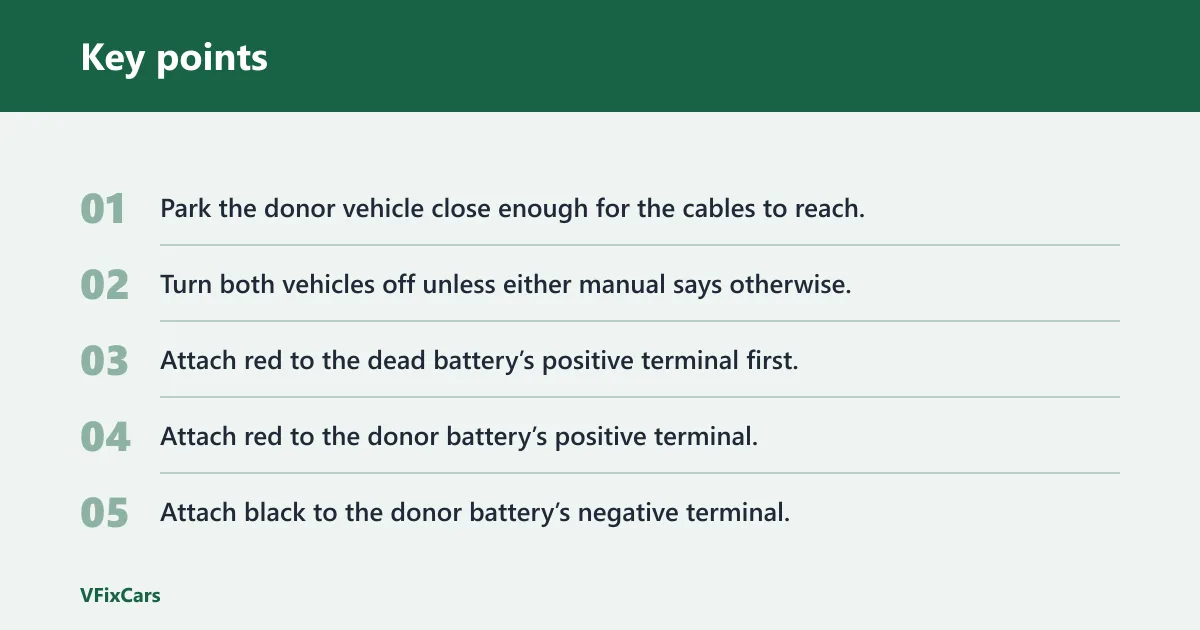
- Park the donor vehicle close enough for the cables to reach, without letting the vehicles touch.
- Turn both vehicles off unless either manual says otherwise.
- Attach red to the dead battery’s positive terminal first.
- Attach red to the donor battery’s positive terminal.
- Attach black to the donor battery’s negative terminal.
- Attach black to an unpainted metal ground on the dead car, away from the battery.
- Start the car using the dead battery and try once.
Do not reverse the order. Do not clamp the black lead to the dead battery’s negative terminal unless a manual specifically says to do so. A common first-timer mistake is cranking again and again when the first attempt fails; that heats cables and starter parts without fixing the battery.
If that didn’t work
- Wait 2 to 3 minutes and inspect every clamp for looseness or ice buildup.
- Try one more start attempt only if the battery case still looks normal.
- If the car won’t start after two jump attempts with a healthy donor vehicle, stop trying and call a tow.
Suppose the car starts on the second attempt, but the dash battery light stays on. That is not a win you can ignore. The alternator recharges the battery while driving, and a battery that starts the car but dies within a few minutes can indicate an alternator problem.
When is the battery frozen?
A frozen battery is not identified by frost on the outside alone. The warning signs are a bulged case, a cracked case, leaking fluid, or a battery that was so discharged in deep cold that freeze damage is plausible. A fully charged battery freezes at around minus 76°F, while a fully discharged battery can freeze around 20°F.
What subzero temperatures change
Below 0°F, the battery’s capacity and cranking output fall sharply, and the decision gets less forgiving. Cold weather can make a battery lose more capacity as temperatures fall further, so a battery that seemed marginal yesterday may fail today. If the car is stranded in severe cold, pause and reassess before any jump attempt.
Why a frozen battery gets thawed first
Do not jump-start a battery with a swollen or cracked case. Let it thaw in a safe place, then have it tested for CCA and internal damage. If it was deeply discharged enough to freeze, replacement is often the practical outcome after thawing and testing.
How long to charge after a jump
A short winter commute may not fully recharge a cold battery. Idling for a few minutes is even less reliable. A longer drive at highway speeds for at least 45 minutes to an hour can better recharge a depleted battery in freezing weather, but that still may not rescue a weak or aged battery.
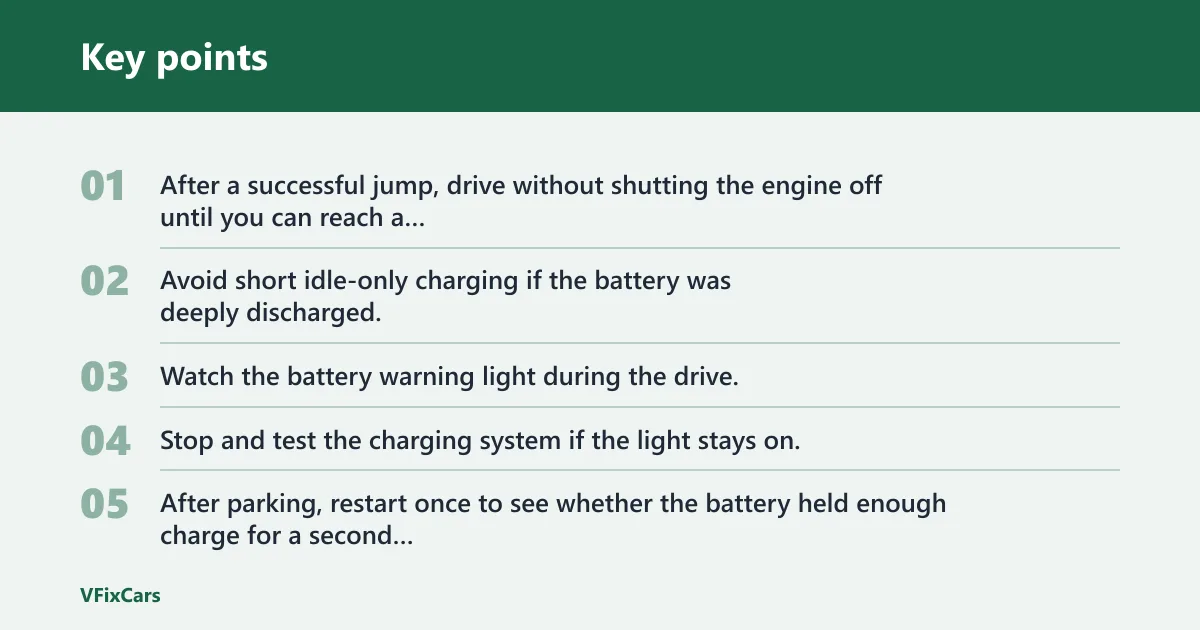
- After a successful jump, drive without shutting the engine off until you can reach a safer stop.
- Avoid short idle-only charging if the battery was deeply discharged.
- Watch the battery warning light during the drive.
- Stop and test the charging system if the light stays on.
- After parking, restart once to see whether the battery held enough charge for a second start.
The alternator can hide a weak battery for one trip and fail to help on the next start. If the engine dies again after a jump, the problem may be the battery, the alternator, or both. That is the point to schedule a battery load test and charging-system check, not another round of guesses.
Common mistakes
Repeated cranking can quickly turn a simple no-start into a bigger problem. It overheats cables, stresses the starter, and wastes the remaining charge. It also makes a weak battery harder to recover later.
- Do not keep jumping a battery with a bulged, cracked, or leaking case.
- Do not rely on a brief idle to recharge a cold battery.
- Do not ignore a battery warning light after the engine starts.
- Do not keep trying after two failed jump attempts with a healthy donor vehicle.
- Do not assume frost on the case means the battery is frozen.
Can cold weather damage a battery that was already weak? Yes. A battery older than three years should be tested before winter use, and vehicle batteries usually last 3 to 5 years. A weak battery that survives mild weather can fail quickly once temperatures drop and capacity falls.
Frequently asked questions
What should I do first if my car battery is dead in cold weather?
Check the battery case, then the start behavior, then the dash lights. If the case is swollen, cracked, or leaking, do not jump it. If the case looks normal and you get one click or rapid clicking, a jump-start is reasonable as long as both manuals allow it.
How do I know if the battery is frozen and unsafe to jump?
A frozen battery is a damaged-or-at-risk battery, not one with surface frost. Look for bulging, cracking, or leakage, and assume freeze risk if the battery was deeply discharged in severe cold. A fully discharged battery can freeze around 20°F, so thawing and testing come first.
Can I jump-start a dead battery when it’s below 0°F?
Sometimes, if the battery case is intact and the car shows no freeze damage. Below 0°F, the battery may have far less usable power, so you need careful cable connections and a fast decision. If the battery looks damaged or the jump fails twice, call a tow.
Should I use jumper cables or a portable jump pack in winter?
Use whichever lets you make a safe, correct connection. Jumper cables work well with a donor vehicle and a bare-metal ground on the dead car. A portable jump starter is useful if the car is parked poorly, cable access is tight, or you want a single-car solution stored in the cabin.
How long should I let the donor car run before trying to start my car?
Follow both vehicles’ manuals first, because procedures vary. In general, a short wait with the connections in place can help transfer some charge before the first attempt, but the key step is still a clean, correct connection. If the first try fails, reassess rather than cranking repeatedly.
When should I call a tow instead of trying another jump?
Call a tow right away if the case is bulged, cracked, or leaking, if the roadside is unsafe, or if the car fails two jump attempts with a healthy donor vehicle. A battery that starts and dies again may point to alternator trouble, which also makes towing reasonable.