How to Choose the Best Car Battery for Your Car
Choose the best car battery by matching the exact group size and terminal layout in your owner’s manual, then select the chemistry your car’s charging system and driving pattern call for; if your trips are short or you drive in cold weather, put reserve capacity and warranty length near the top of the list. A wrong fit can lead to no-starts, charging faults, and earlier battery failure. This guide gives you a vehicle-first checklist for size, type, and warranty.
Matching battery types to driving habits and vehicle demands
The best default choice is the battery your vehicle specifies, with the correct group size and terminal layout first, then the chemistry matched to the charging system. For many modern cars with stop-start or heavier electrical loads, that means AGM. For older, simpler vehicles, a fresh flooded battery often fits the job better.
Top pick for factory-fit replacement
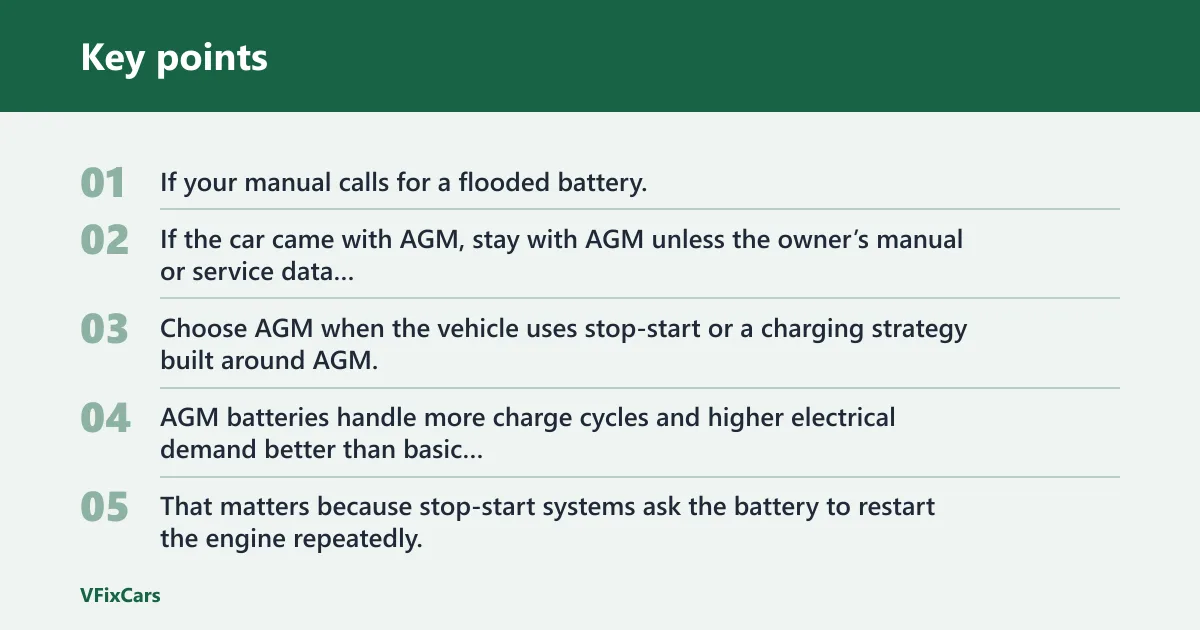
If your manual calls for a flooded battery, match that size and keep the same chemistry unless the maker allows a different type. If the car came with AGM, stay with AGM unless the owner’s manual or service data clearly approves another option. Fitment comes first.
Best choice for stop-start vehicles
Choose AGM when the vehicle uses stop-start or a charging strategy built around AGM. AGM batteries handle more charge cycles and higher electrical demand better than basic flooded units. That matters because stop-start systems ask the battery to restart the engine repeatedly.
Best choice for short-trip driving
Short trips leave less time for the alternator to recover charge. A vehicle that makes many short drives of about five to ten minutes may benefit from AGM, or from a battery with strong reserve capacity and a fresh date code. Weak charging recovery shortens life fast.
Best choice for cold-weather starting
In cold weather, prioritize a battery with the correct size and a higher CCA rating within the vehicle maker’s allowed range. Cold cranking amps matter most when temperatures drop, because the engine needs more starting force and the battery gives less of it.
📊 Car and Driver lists the Optima RedTop at 12 volts and 800 cold cranking amps. Source: How to Choose the Best Car Battery.
Quick picks
Use this as a fast filter, not a brand list. The right battery still has to match group size, terminal layout, and the vehicle’s charging system before you compare specs.
- If your car came with AGM: buy AGM again, unless the manual allows a different type.
- If your car uses flooded lead-acid: replace with the same group size and terminal layout, and only move to AGM if the vehicle supports it.
- If you drive short trips: prioritize AGM or, at minimum, a fresh battery with solid reserve capacity.
- If you need more accessory support: prioritize reserve capacity over chasing the highest CCA number.
What battery size does your car need?
The right battery size is the one listed for your vehicle in the owner’s manual, then confirmed by a fit guide at the parts counter or online. Battery group size controls physical dimensions, terminal location, and terminal type. If any of those are wrong, the battery may not fit or may not connect safely.
Use the owner’s manual first
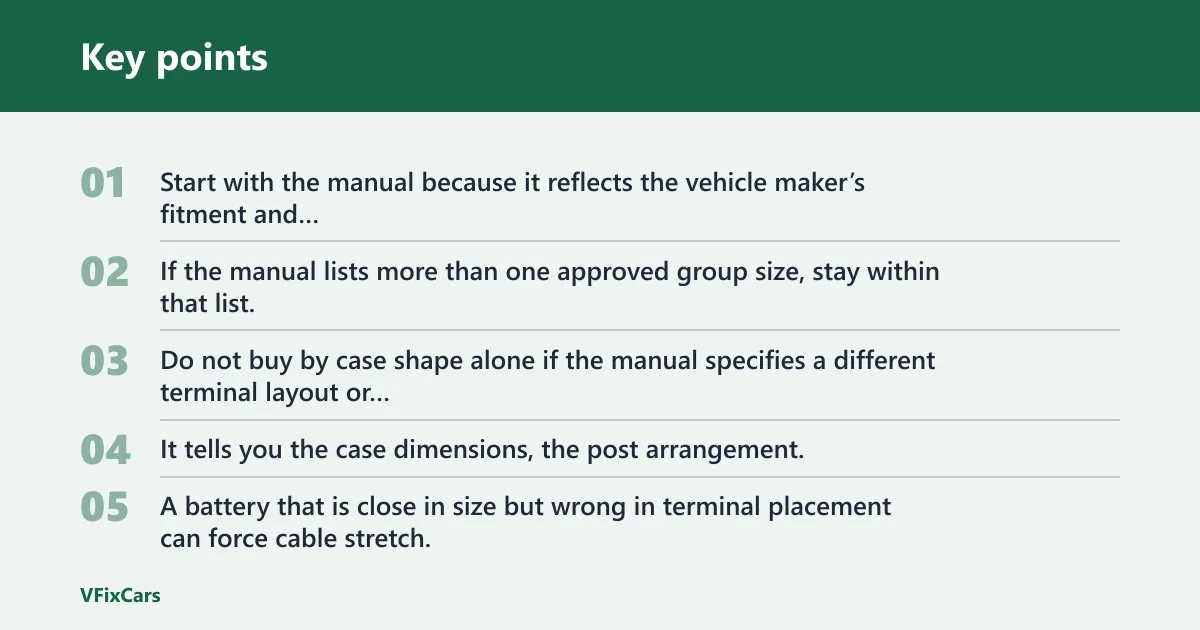
Start with the manual because it reflects the vehicle maker’s fitment and charging-system requirements. If the manual lists more than one approved group size, stay within that list. Do not buy by case shape alone if the manual specifies a different terminal layout or hold-down style.
Check group size, dimensions, and terminal layout
Group size is not just a label. It tells you the case dimensions, the post arrangement, and often the terminal orientation. A battery that is close in size but wrong in terminal placement can force cable stretch, poor routing, or a hold-down that will not secure it properly.
Confirm terminal type and hold-down fit
Some batteries use top posts, some use side terminals, and some vehicles are designed for a specific orientation. Confirm the terminal type, the side of the positive post, and the hold-down points before buying. Wrong terminal orientation is a common fitment mistake and a clear warning sign.
Use the in-store fit guide as a cross-check
Fit guides are useful, but they should confirm the manual, not replace it. Cross-check the group size, terminal layout, and engine-specific listing. If the guide conflicts with the owner’s manual or service information, follow the vehicle maker.
Should you buy AGM or flooded?
Buy AGM when the vehicle was designed for it, when stop-start is fitted, or when the electrical load is higher than average. Buy flooded lead-acid when that is the factory spec and the car does not need AGM-level cycle durability. AGM is not automatically better for every vehicle.
What AGM changes in daily use
AGM uses absorbed glass mat construction, which helps it tolerate more charge cycles and higher accessory demand. That makes it common in modern cars and useful for vehicles with stop-start systems. It also tends to recover better under repeated partial charging than basic flooded batteries.
When flooded lead-acid is the right call
Flooded lead-acid remains common in many cars, and it is still the correct choice when the vehicle maker specifies it. If the charging system and electronics were not designed around AGM, there is no reason to pay extra for chemistry the car does not need.
When an AGM-to-flooded swap is risky
Replacing AGM with flooded is only acceptable when the vehicle maker allows it. Otherwise, the charging strategy, battery monitoring, or stop-start logic may not behave correctly. That can lead to undercharging, shorter life, or warning lights that point back to the battery system.
How stop-start systems change the choice
Stop-start systems place repeated load on the battery and usually call for AGM. If the car came from the factory with AGM, treat that as a fitment requirement, not an upgrade opportunity. A flooded battery in that role is a cost cut that can fail early.
Battery decision matrix
This matrix turns driving pattern into a practical recommendation. Use it after confirming group size, terminal layout, and the vehicle maker’s approved battery types.
| Scenario | Recommended battery type | Minimum CCA priority | Fitment checks | Red flags |
|---|---|---|---|---|
| Stop-start vehicle | AGM | Match manual spec; do not downgrade | Exact group size, terminal type, battery-monitoring compatibility | Flooded swap without maker approval, wrong terminal orientation |
| Short-trip commuter | AGM, or the factory-specified flooded type with strong reserve capacity | Vehicle spec, with priority on reserve support | Correct group size and hold-down fit, fresh date code | Old stock, undersized battery, assuming higher CCA solves short-trip charging loss |
| Weekend or infrequent-use car | AGM if parasitic load is a concern; otherwise factory-specified type | Vehicle spec | Correct fit plus fresh stock | Buying by brand alone, ignoring storage and discharge risk |
| Cold-weather driver | Factory-specified type, often AGM in newer cars | Higher CCA within approved range | Manual-listed size, terminal layout, cold-weather rating | Picking the highest CCA without fitment checks |
| Audio or accessory load | AGM, if the charging system supports it | Reserve capacity first, then CCA | Correct group size and charging-system compatibility | High-load use with a basic flooded battery and weak reserve capacity |
Say your car has stop-start, a battery sensor, and a manual listing for AGM. The correct move is not a higher-CCA flooded unit from a shelf tag. It is the specified AGM group size with the right terminals and hold-down.
Picture a weekend coupe that sits for long stretches and runs a stereo amplifier. A battery with decent CCA may still disappoint if reserve capacity is weak. In that case, the better choice is the correct-size AGM with stronger backup runtime and a recent date code.
How do CCA, reserve capacity, and date code matter?
CCA, reserve capacity, and date code each answer a different question. CCA covers starting power, reserve capacity covers backup runtime under load, and date code tells you how fresh the battery is. Use them together, after fitment is confirmed, not as substitutes for fitment.
Why CCA matters most in cold weather
Cold cranking amps are a starting-power rating. Higher CCA helps in cold climates, but only within the vehicle maker’s approved range. A battery that fits badly or is the wrong chemistry is still the wrong battery, even if the CCA number looks strong.
How reserve capacity helps under load
Reserve capacity matters when the charging system is stressed or when accessories draw power with the engine off. It gives you a buffer during short idles, heavy accessory use, or situations where the alternator cannot keep up. That makes it useful for commuters and audio builds.
How to read the battery date code
Look for the shipping or date label on the case. Buy the freshest stock you can. Consumer Reports recommends a battery less than 6 months old, with 3 months even better. Old stock loses value before you ever install it.
What counts as fresh stock
A fresh battery is one with a recent manufacture date and no long shelf time. The same source says battery life typically runs three to five years, with life varying by region. It can be 58 months or more in far northern U.S. areas and less than 41 months in the most southern regions.
What warranty is worth paying for?
The most useful warranty is the one with a long free-replacement period, not just a long total term. Warranty labels should be read as two parts: free replacement and prorated coverage. A long prorated tail matters less than a solid front end if the battery fails early.
Free replacement period versus prorated period
The free replacement period is the part that matters most because it tells you how long a bad battery is covered without extra cost. Prorated coverage may still leave you paying a meaningful share later. That is why two batteries with similar total terms can have very different value.
How to read 24/84-style terms
A 24/84 warranty means 24 months of free replacement and 84 months of prorated coverage. That split is worth reading carefully. The first 24 months are the part that usually protects you best if the battery is a dud or fails too soon. (Consumerreports)
Why warranty length is not the whole story
A longer number on the label does not make a battery the right choice. Fitment, chemistry, freshness, and charging-system compatibility still come first. A shorter but better-aligned warranty on the correct battery can beat a longer warranty on the wrong one.
How to choose the best car battery
Start with fitment, not marketing. Confirm the exact group size, terminal layout, and hold-down style in the owner’s manual, then choose AGM or flooded based on the vehicle’s factory spec and your driving pattern. After that, compare CCA, reserve capacity, date code, and warranty value.
A practical buying checklist
- Confirm the exact group size in the owner’s manual.
- Match terminal location, terminal type, and hold-down fit.
- Choose AGM only when the vehicle calls for it or benefits from it.
- Use CCA for cold-weather starting, not as the only buying metric.
- Check reserve capacity if you use accessories or short trips.
- Read the date code and avoid old inventory.
- Compare warranty terms as free replacement first, prorated second.
A common first-timer mistake is buying the right chemistry with the wrong terminal layout. The battery may look correct on the shelf, then fail the moment the cables cannot reach cleanly or the hold-down will not secure it.
Fitment red flags to stop
Stop if the group size is wrong, the terminals face the wrong way, the vehicle requires AGM but the new battery is flooded, or the choice is made by brand name alone. Those are fitment mistakes, not tradeoffs.
Frequently asked questions
What’s the best battery for your car?
A good battery choice is one that matches the group size, terminal layout, and chemistry your vehicle maker specifies. If your car came with AGM, use AGM again. If it came with flooded lead-acid, stay with that unless the manual allows a change.
Which is the best battery for a car?
There is no single best battery for every car. The best choice depends on the vehicle’s approved fitment, whether it uses stop-start, how often you drive short trips, and whether you need extra reserve capacity for accessories. Start with the manual, then compare specs.
How do I know what size car battery I need?
Check the owner’s manual first, then confirm the group size, terminal position, and hold-down style in a fit guide or at the parts counter. If the battery is the wrong physical size or the posts are on the wrong side, it is not the right battery.
Should I buy an AGM or regular lead-acid battery?
Buy AGM if the car has stop-start, came with AGM from the factory, or carries heavier electrical loads. Buy regular flooded lead-acid when that is the vehicle’s original spec and the manual does not call for AGM. Do not treat AGM as a universal upgrade.
How old can a replacement car battery be?
Buy the freshest battery you can find. The same source recommends less than 6 months old, with 3 months even better. A battery can sit on the shelf and lose value before installation, so date code matters almost as much as the label on top.
What battery warranty is worth paying for?
Look first at the free replacement period, then at the prorated period. A 24/84 warranty means 24 months free replacement and 84 months prorated coverage. That is more useful than a long total term with a short free-replacement window.