Are Roof Racks Worth It for Everyday Drivers?
For most everyday drivers, a roof rack is worth it mainly if you need it on about 10 or more days a year, or for one recurring cargo job; otherwise, a removable or hitch-mounted option usually makes more sense. Leaving one on year-round can add wind noise, drag, height limits, and extra cost that you may never recover. This guide weighs frequency, fuel penalty, clearance, security, and better alternatives so you can decide fast.
Roof rack basics

A roof rack system is more than bars. It usually includes crossbars, foot packs or towers, and the vehicle-specific hardware that connects everything to raised rails, fixed points, factory mounting points, or a bare roof fit kit. The number that matters is the vehicle’s load rating, not the rack’s sales copy.
Roof rails, crossbars, and mounting points each do a different job. Roof rails run front to back; crossbars run side to side and carry the cargo. A vehicle may have raised rails, flush rails, fixed points hidden under covers, or a bare roof with no visible attachment points. That detail changes what rack parts you need.
What a roof rack system includes
Most systems use base rack parts, crossbars, and a fit-specific mounting kit. Some vehicles need foot packs or towers that clamp to rails. Others use factory mounting points or a door-jamb style fit kit on a bare roof. If the fit is wrong, the rack may not sit level or may not meet the vehicle’s rated load.
Roof rails, crossbars, and mounting points
Raised rails are easier to attach to because the bars sit above the roof. Flush rails sit closer to the roofline and usually need model-specific feet. Factory mounting points are designed for a rack from the start. Bare roofs need the most exact fitment, because the rack must avoid dents, leaks, and misalignment.
How vehicle fitment changes the setup
Fitment varies by vehicle roof structure: bare roof, raised rails, fixed points, or factory mounting points. That changes the parts list, the installation time, and the available load rating. A rack that fits one sedan may not fit another with the same model year if the roof hardware is different.
Are roof racks worth it for everyday drivers?
For everyday drivers, the rack is worth it when the cargo need happens often enough that constant setup is the smaller burden. If you carry bikes, skis, ladders, or a cargo box most weeks, a permanent setup can make sense. If the need is rare, the ongoing drag, noise, and height hassle usually outweigh the convenience.
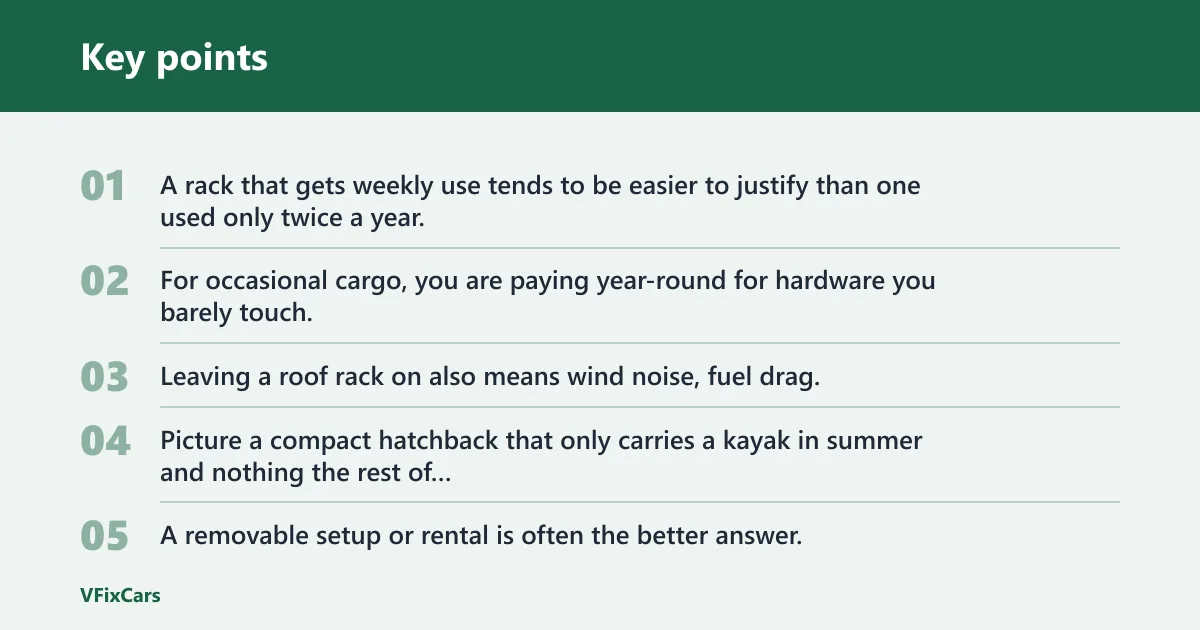
The practical rule is frequency. A rack that gets weekly use tends to be easier to justify than one used only twice a year. For occasional cargo, you are paying year-round for hardware you barely touch. Leaving a roof rack on also means wind noise, fuel drag, and extra roof height every time you park.
Picture a compact hatchback that only carries a kayak in summer and nothing the rest of the year. A removable setup or rental is often the better answer. Now picture a driver who hauls two bikes every Saturday. That driver gets real value from leaving a rack on the car.
When convenience beats overhead cost
Convenience beats overhead cost when the rack saves repeated loading hassle on a regular schedule. That is most true for bike commuters, frequent skiers, or tradespeople who need roof access on most weeks. In those cases, a setup that stays ready can be worth the drag.
When leaving it off makes more sense
If cargo use is seasonal or rare, the smarter choice is often to leave the rack off and use another carrier only when needed. The reason is simple: a permanent roof rack keeps charging you in small ways every day, even when it is empty.
Roof rack decision table
This table turns yearly use frequency into a practical choice. The cost figures are simple planning estimates, not universal prices. The point is to compare the yearly burden of keeping hardware on the car against the convenience of having it ready.
| Use pattern | Estimated yearly cost | Convenience score | Noise risk | mpg penalty risk | Garage-clearance risk | Better alternative |
|---|---|---|---|---|---|---|
| Weekly use | Low to moderate, because the rack gets used often enough to justify it | High | Medium to high if left on | Medium to high | Medium to high | Leave it on |
| Monthly use | Moderate, since convenience matters but not every week | Medium | Medium | Medium | Medium | Use removable crossbars |
| Seasonal use | Moderate to high, because idle months still carry drag and noise | Low to medium | Medium to high | Medium to high | High in garages and drive-thrus | Use a hitch carrier |
| One-off use | High relative to use, because the rack sits unused most of the year | Low | Medium to high | Medium | High | Rent when needed |
A common first-timer mistake is buying a full rack for one summer road trip and then leaving it on for years. That often turns a one-time cargo need into a permanent noise and clearance issue. If use is truly rare, rental or borrowing is usually the cleaner choice.
Do roof racks hurt gas mileage?
Roof racks can hurt gas mileage because they add drag, and drag generally rises as speed rises. The effect is usually small in city driving and more noticeable on the highway, where wind resistance matters more. A removable setup that comes off when not needed avoids paying that penalty every day.
The size of the hit depends on rack shape, width, height, and what you carry. Empty crossbars still create resistance. Cargo boxes, bikes, and other accessories raise it more. A rack that stays on all year has a longer fuel penalty window than one removed after each use.
Why drag rises at speed
Air pushes harder as speed climbs, so roof hardware that looks minor around town can matter more at highway speeds. Aero bars usually manage airflow better than square bars, but they still add some drag. More accessories mean more turbulence and more penalty.
City driving versus highway driving
In city use, stop-and-go traffic and lower speeds keep the impact smaller. On the highway, the rack works against you more often because the car spends more time in steady airflow. That is why long interstate driving makes the yearly cost easier to notice.
Permanent setups versus removable setups
Permanent setups cost more in fuel because the drag never stops. Removable crossbars or a rack that comes off after each trip reduce that ongoing loss. If the rack is only useful a few times a year, taking it off is usually the better trade.
Do roof racks make a lot of wind noise?
They can. Wind noise depends on bar profile, bar width, speed, and what else is mounted on top. Square bars tend to be noisier than aero-shaped bars. Even quiet racks can become noticeable above highway speed, especially with accessories left on the car.
Noise is not only annoying. It is also a sign that airflow is being disturbed enough to matter. Fairings can help in some setups, and so can keeping accessories off the rack when you are not using them. A bare roof is still quieter than any rack system.
Bar shape and width
Aero bars usually make less noise than square bars because their shape cuts the air more cleanly. Wider bars and exposed mounting hardware can add whistle or hum. The more surface the wind sees, the more sound you can expect.
How speed changes noise
Noise tends to rise with speed. A setup that seems acceptable at neighborhood speeds can become tiring on a long freeway drive. That matters for daily drivers, because the rack is present on every commute even when cargo is not.
When fairings or accessories help
Fairings can reduce some airflow noise, but they are not a cure-all. Extra accessories such as bike trays, cargo baskets, and empty mounting parts can still whistle. The quietest solution is often the simplest one: remove what you do not need.
Weight, clearance, and damage risks
Weight and clearance are where roof racks move from convenient to risky. The relevant limit is the vehicle’s dynamic roof load, rather than the rack’s own rating alone. You also need enough clearance for garages, parking decks, and drive-thrus.
Load distribution matters. Put weight evenly across the crossbars and keep heavy items low and centered. Overloading the roof can stress the roof structure, reduce handling margin, and create leak or trim issues over time. Roof cargo is not the place to guess.
Dynamic roof load and weight distribution
The dynamic roof load is the maximum load the vehicle can carry while moving. It can be lower than the rack’s advertised capacity. The safer rule is to follow the lower number, then spread the load evenly across the bars and mounting points.
Garage clearance and parking height
Raised rails and tall cargo can push a vehicle over its usual clearance. That matters in garages, drive-thrus, and low parking structures. A driver who forgets the new height can scrape the roof, the cargo box, or the doorway frame.
Paint, trim, and car-wash concerns
Improperly fitted racks can mark paint, pinch trim, or leave rub points on the roof. Fixed points and factory mounting points are designed for a rack, but even then, the fit has to be correct. Some car washes also reject roof-mounted accessories, so check before entering.
Do roof racks damage your car roof or paint? Not if the system fits the vehicle correctly and is installed within the load rating. Damage risk rises with poor fitment, loose hardware, overloading, and repeated rubbing from straps or accessories. A correct setup is safer than a universal guess.
Frequently asked questions
Are roof racks worth it for everyday driving?
They are worth it when you use them often enough that convenience beats the ongoing cost. For most drivers, that means regular weekly or near-weekly cargo use. If the rack is only for a few trips each year, a removable or hitch-mounted option usually makes more sense.
Can I leave a roof rack on my car all the time?
Yes, if the fit is correct and the vehicle’s load rules are respected. The better question is whether you should. Leaving it on all the time can add noise, fuel drag, height problems, and car-wash friction that make sense only if you use it often.
How much weight can a roof rack safely carry?
The safe limit is the lower of the vehicle’s dynamic roof load and the rack system’s rating. Do not assume the rack hardware sets the limit. Check the manufacturer numbers, then account for the weight of the bars, mounts, and cargo itself.
When is a hitch carrier better than a roof rack?
A hitch carrier is often better for heavy, bulky, or frequent cargo because it avoids roof-height problems and usually creates less wind drag than rooftop loads. It is especially useful when lifting items overhead is awkward or when garage clearance is tight.
Do I need a roof rack if I only carry bikes or luggage sometimes?
Not always. If the need is occasional, a removable rack, hitch carrier, rear cargo box, trunk-mounted carrier, or rental may be smarter. The fewer days per year you use it, the harder it is for a permanent roof rack to pay for itself.
Are roof racks worth the extra cost for a daily driver?
Only when the rack solves a regular problem. Daily drivers who carry cargo often can justify the cost, but rare-use drivers usually cannot. If the rack sits empty most of the year, you are paying for noise, drag, and clearance headaches without much return.