Why does my check engine light come on and go off?
A check engine light that comes and goes can mean the engine computer found an intermittent fault, saved a pending or history code, and may turn the lamp back on after a few drive cycles if the problem is still there. Ignoring it can hide a misfire, increase fuel use, or let a repair get costlier later. This guide explains why the light disappears, how memory codes work, and how to tell whether the fault is gone or only hiding.
This guide is part of our Check engine light: meaning, causes, and what to do series.
What it means when the check engine light comes and goes
How the ECM or PCM decides when to turn the light on
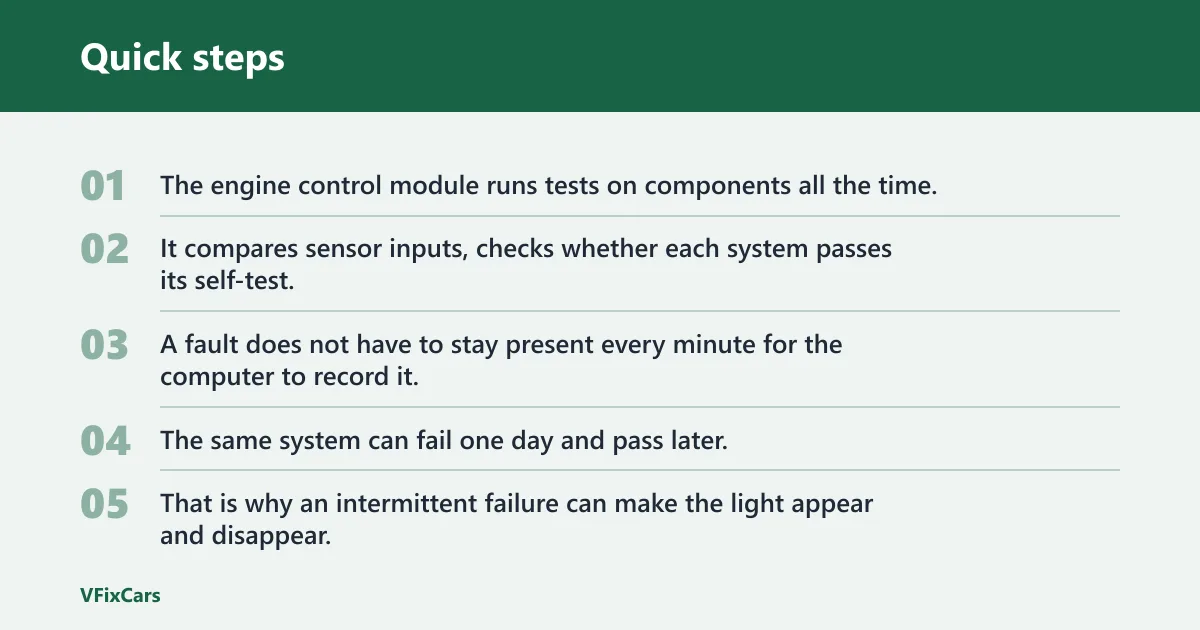
The engine control module runs tests on components all the time. It compares sensor inputs, checks whether each system passes its self-test, and then decides whether to command the warning lamp. A fault does not have to stay present every minute for the computer to record it.
The same system can fail one day and pass later. That is why an intermittent failure can make the light appear and disappear. The computer is not guessing; it is recording a result from one drive cycle and then repeating the test on another.
Why one drive cycle can fail and the next can pass
Readiness monitors are self-test routines that may not run every trip. If a monitor does not run, it cannot report a failure. If it does run and the operating conditions are right, the same fault may appear again.
This is why a light can go out after a few starts and still come back. The vehicle may not have “fixed itself.” It may simply have moved out of the condition that exposed the fault.
Why a light that goes off can still leave a code behind
A code can stay stored even after the light turns off. OBD-II diagnostic trouble codes are kept in the vehicle computer and used as the starting point for diagnosis. That stored history is often the best clue when the dashboard looks normal again.
Pending codes, stored codes, and permanent codes are not the same thing. A pending code means the computer saw a problem but has not yet confirmed it on enough drive cycles. A stored code means the fault met the criteria to be saved. A permanent code can remain until the system passes its required checks, even after the lamp turns off.
Why does my check engine light come on and go off by itself?
That pattern usually points to an intermittent failure that only shows up under certain conditions, then disappears before the next self-test. The computer can set a fault on one trip, clear the lamp on another, and still keep useful memory data. The light is following fault logic, not acting at random.
Pending, stored, and permanent codes in plain language
Pending codes are early warnings. Stored codes are confirmed faults. Permanent codes are a separate layer of memory that helps prevent a quick reset from hiding a problem. If the light went off, you still need to know which type of code remains.
That difference matters because a shop can use stored and pending data to decide what to test first. Without that step, intermittent problems often get blamed on a vague “computer glitch,” which is rarely a helpful diagnosis.
How readiness monitors affect whether the fault shows up again
Readiness monitors do not all run at the same time. Some need a cold start. Some need steady cruise. Some need deceleration, idle, or a specific fuel level. If the right monitor does not run, the fault may stay hidden on that trip.
Suppose the light comes on during a short city drive, then disappears after a highway run the next day. That difference often points to a monitor that only runs under one set of conditions, not a problem that vanished for good.
Why the same issue may not trigger the lamp every trip
Weather and driving conditions can change whether the issue reappears during diagnosis. Temperature, trip duration, speed, and electrical load all change how the system acts. The fault may be present, but the computer may not see it on every drive.
Electrical load is one factor to note when troubleshooting. A/C, headlights, the blower, and the radio can add demand. That extra load can expose weak wiring, poor grounds, or a sensor signal that looks fine until the system is stressed.
Weather and operating conditions that trigger intermittent faults
Weather, trip length, engine temperature, and speed can change whether a fault appears. A cold morning, a short errand, or a hot restart after a long stop can all produce different results from the same vehicle. Those clues matter more than the dash light’s current status.
Cold starts, heat soak, and short trips
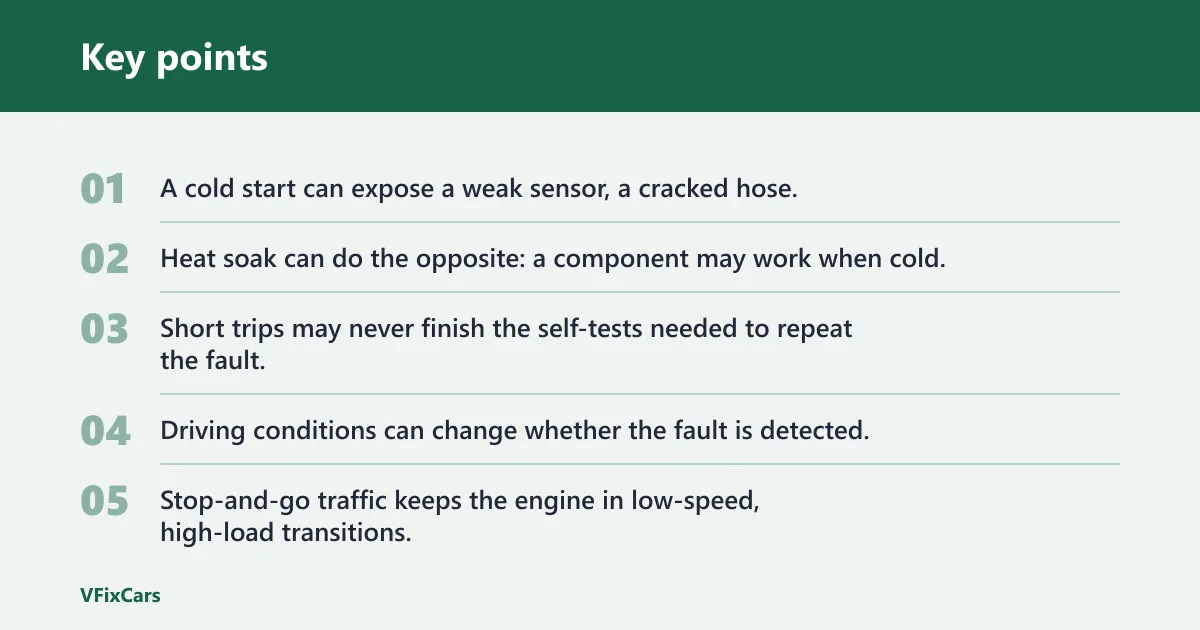
A cold start can expose a weak sensor, a cracked hose, or a fuel trim problem before parts warm up. Heat soak can do the opposite: a component may work when cold, then open or drift out of range after the engine bay gets hot. Short trips may never finish the self-tests needed to repeat the fault.
Highway speed versus stop-and-go driving
Driving conditions can change whether the fault is detected. Stop-and-go traffic keeps the engine in low-speed, high-load transitions. Highway driving keeps it steady for longer periods. Some problems show up only in one of those patterns.
Accessory load from A/C, headlights, blower, and radio
Electrical demand can matter as much as road speed. A weak alternator circuit, a loose connector, or a poor ground may act up only when several accessories run together. That is why a note like “lamp came on with A/C, headlights, and blower on” is useful.
Why does my check engine light come on and off by itself?
Because the ECM or PCM tests systems continuously, it can see a fault one trip and pass the same system later. If the fault is intermittent, the lamp may cycle on and off while the underlying issue remains. The disappearance of the light does not prove the cause is gone.
Fuel, spark, and air faults that show up under demand
When acceleration increases load, fuel pressure, ignition strength, and airflow all have to keep up. A weak pump, a marginal coil, or a sensor that drifts under load may look normal at idle and fail under throttle. That is why acceleration complaints deserve attention even if the lamp clears.
Misfires and sensor signals that change with engine load
Misfire data often changes with throttle position and engine speed. A slight break in wiring or a sensor that opens and closes can distort the signal only when the engine shakes or the wiring moves. Those faults can be brief and still important.
A common first-timer mistake is to drive for five minutes, see the lamp go out, and assume the issue is fixed. A better approach is to note the exact conditions, then reproduce them on purpose. That is how a shop gets past the “could not duplicate” result.
What causes an intermittent check engine light?
Common causes include a loose gas cap, EVAP venting issues, sensor faults, loose plugs, corroded connectors, and wiring that opens or closes intermittently. The pattern usually matters more than the part name. The question is when the fault appears, not just what code shows up.
Fuel cap and EVAP venting issues
The fuel cap and EVAP system are common intermittent triggers. A cap that does not seal, a vent valve that sticks, or a small leak that changes with temperature can set a code and then self-clear after several successful drive cycles.
That does not mean every EVAP code is minor. It means the problem can appear only after fueling, during a long cruise, or after the car sits in heat. The lamp going out simply means the monitor passed later.
Loose plugs, corroded connectors, and wiring breaks
Sensor and connector faults are a major reason intermittent codes are hard to catch. A loose plug can make contact on one trip and open on the next. Corrosion can add resistance that shifts with moisture, vibration, or temperature.
These are often shop-level faults that need movement, heat, and repeated testing. Multiple test drives may be needed to confirm the issue, and for proper diagnosis, the problem may need to occur at least two times in the shop.
Sensors that fail only when hot or vibrating
Some sensors fail only when hot, while others fail when vibration changes the internal connection. If a pressure-sensor issue makes a warning light turn on and off, the sensor may be fouled by dirt or foreign matter, or it may simply be out of range under a specific load.
Why does my check engine light come on and off when accelerating?
Acceleration raises engine load, so weak fuel delivery, ignition problems, air leaks, and sensor faults are more likely to show up. If the lamp appears during throttle tip-in and then clears later, the fault may still be present even if the car drives normally at cruise.
When a brief symptom still matters
A short flash or brief warning is still worth documenting. A code can remain stored after the light turns off, and the freeze-frame data may capture engine speed, load, and temperature at the moment the fault was detected. That record can point directly to the failing system.
Picture a load-related fault
Picture a 2.4-liter sedan that runs fine at idle, then turns the light on during a hill climb with the A/C on and the headlights lit. If the lamp goes off after the next key cycle, the underlying fault may still be waiting for the same load pattern to return.
Use this worksheet to capture the fault for diagnosis
A scan tool or code reader is needed to confirm stored and pending codes, even if the light is off. That tool is only the start. A good intermittent-fault worksheet gives the shop a way to reproduce the same trip conditions, temperature, and load that made the problem appear.
| Trip # | Trip length | Ambient temperature | Engine temperature | Speed/load | Accessory load | Light reappeared? |
|---|---|---|---|---|---|---|
| 1 | 8 miles | 34°F | Cold start | Stop-and-go | A/C off, headlights on | Yes |
| 2 | 22 miles | 82°F | Fully warm | 55–65 mph highway | A/C on, blower high | No |
| 3 | 5 miles | 88°F | Heat soak after 30 minutes parked | Light throttle | Radio on, A/C on | Yes |
What to record every time the light appears
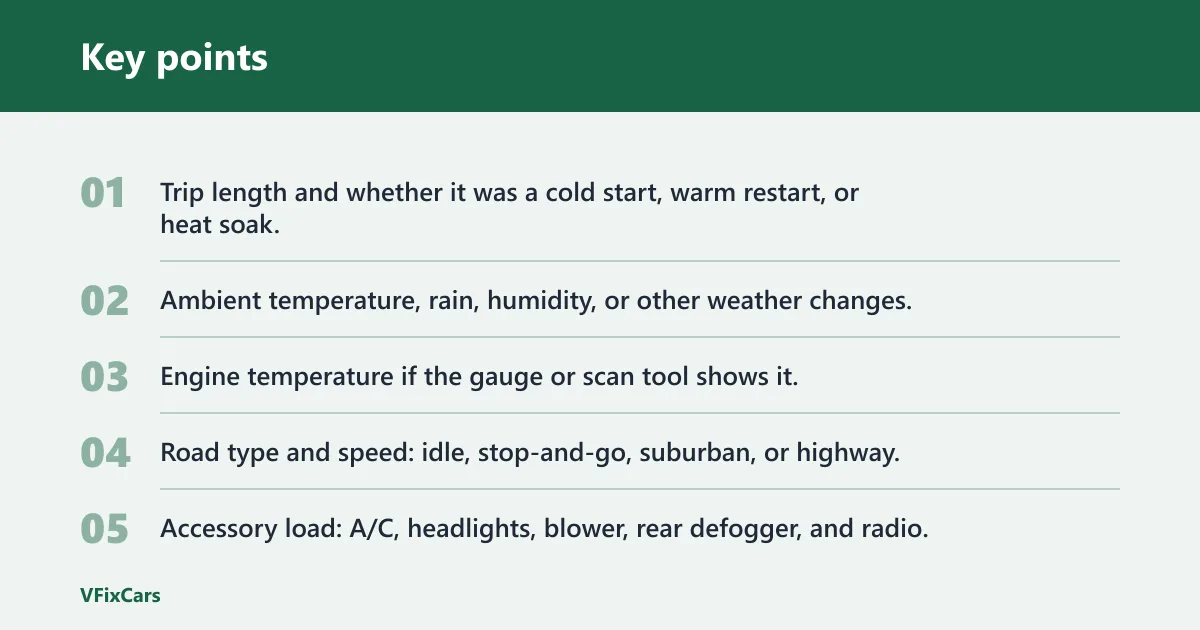
- Trip length and whether it was a cold start, warm restart, or heat soak.
- Ambient temperature, rain, humidity, or other weather changes.
- Engine temperature if the gauge or scan tool shows it.
- Road type and speed: idle, stop-and-go, suburban, or highway.
- Accessory load: A/C, headlights, blower, rear defogger, and radio.
- Whether the light stayed on, flashed, or turned off again.
- Any smell, rough idle, stumble, hesitation, or fuel-cap change.
How to use the notes with a shop
Bring the code numbers, the freeze-frame data, and the worksheet. Ask the shop to duplicate the same start condition and drive pattern before clearing anything. That approach gives the technician a better chance of catching the fault in the same state that set it.
Can a check engine light go off but still have a code?
Yes. A check engine light can go off and still have stored, pending, or permanent codes in memory. The dash only shows the current warning state. The vehicle computer may still hold the evidence needed to diagnose the fault correctly.
Why stored codes may remain after the lamp turns off
An intermittent failure can disappear before the next drive cycle, but the ECM or PCM still keeps the code. That history is often the best clue when the symptom is gone by the time the car reaches the bay.
If the oil light comes on at low rpm and then shuts off, the pump may be fine. A pressure-sensor issue can make a warning light turn on and off, and the sensor can be fouled by dirt or foreign matter. The pattern, not just the lamp, tells the story.
How to use a scan tool to check current and history data
A scan tool should be used even if the dash light is off. Check current codes, pending codes, stored history, and permanent codes. Review freeze-frame data, then compare it with the worksheet notes so you can match the trip conditions that caused the fault.
Is it safe to ignore a check engine light that went back off?
It is safer to treat a light that went back off as an unresolved fault until a scan proves otherwise. Some issues are minor, but intermittent misfires, EVAP leaks, and wiring faults can return under the same conditions. If the light flashed, the car runs poorly, or the engine sounds different, treat it as urgent.
When to keep driving
If the car drives normally, the light is steady, and there is no overheating, severe shaking, or fuel smell, you can usually drive short distances while you gather codes and notes. Do not clear the codes first. That removes useful history.
When to schedule service soon
If the light has come and gone more than once, schedule service and bring the worksheet. The repeated pattern helps separate a passing monitor from a fault that is still active. Multiple test drives may be needed to confirm it.
When to stop driving and get help now
If the check engine light flashes, the engine misfires badly, or the vehicle loses power, stop driving as soon as it is safe. Those signs point to a problem that can damage the catalytic converter or leave you stranded.
Why won’t a mechanic find the problem if the light went off?
Because intermittent faults often need the same temperature, speed, load, and drive cycle that triggered them in the first place. If the light is off, the shop may still find codes and freeze-frame data, but it may need repeated testing to reproduce the failure under the right conditions.
Why reproduction matters more than a guess
Intermittent failure can be hard to reproduce in a shop because the conditions rarely match the customer’s route. A technician may need the vehicle cold, then hot, then under load, with accessory demand added in the same order that the fault first appeared.
Shop-level tactics that help capture the fault
Freeze-frame review, pending-code checks, and drive-cycle notes are the starting point. From there, the technician can test the suspected circuit, inspect connectors for movement or corrosion, and watch live data while recreating the load. That is the practical way to turn a disappearing problem into a diagnosed one.
Frequently asked questions
Why does my check engine light come on and go off?
It usually means the engine computer detected an intermittent fault, stored code data, and then passed the system on a later drive cycle. The light may go off before the problem is fully gone, so scan for pending, stored, and permanent codes before assuming it fixed itself.